
Table of Contents
- Night Shift Commercial Painting: The Real Cost Breakdown
- How Commercial Painting Downtime Affects Your Bottom Line
- After-Hours Commercial Painting Cost: What Drives the Premium
- Commercial Painting Project Timeline: Day vs. Night Schedules
- What a Commercial Interior Painting Estimate Should Include
- Decision Framework: When Night Shift Commercial Painting Pays Off
- Conclusion: Weighing the Premium Against Business Continuity
- Frequently Asked Questions
Last Updated: October 5, 2026
Night Shift Commercial Painting: The Real Cost Breakdown
Night shift commercial painting schedules coating work outside operating hours, usually between 10 p.m. and 6 a.m., so business continues uninterrupted. The trade-off: you pay a labor premium and avoid closing your doors.
At Details Paint Co, we quote both schedules constantly for offices, retail spaces, and property managers. The gap comes down to three line items: the hourly rate, setup and protection time, and hours actually available in a shift.
The premium is not a flat markup but the sum of real, quantifiable costs, once broken out, you can decide which ones your project needs.

Day-Shift Labor Rates vs. Night-Shift Loading
Night-shift loading is the additional hourly amount a contractor charges for after-hours work, reflecting the higher base wage paid to overnight crews.
A two-painter crew is standard for most commercial interiors. Day shift pays the standard hourly rate; night shift adds a loading factor covering the higher wage and a harder environment: reduced visibility, more equipment to move, and fewer trades available if something goes wrong.
Loading is not uniform: a short after-hours touch-up carries a modest premium, while a full overnight repaint of an occupied floor carries more because conditions slow the crew down.
Setup, Pack-Down, and Surface Protection Costs
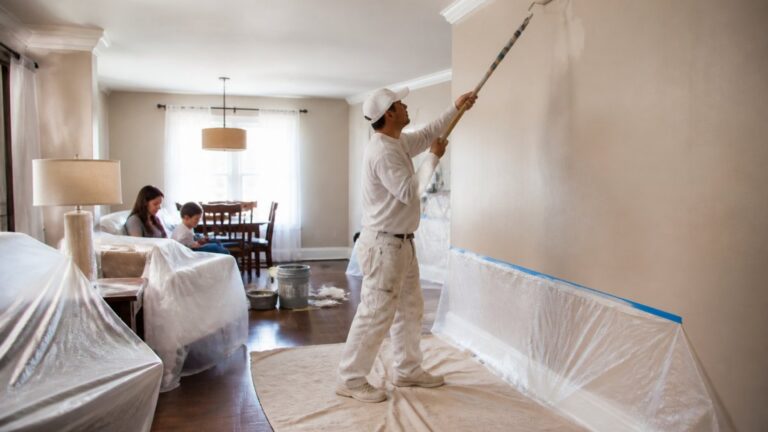
Setup and pack-down eat more of a night shift than a day shift, a cost many estimates bury. In an occupied facility, the crew must protect furniture, equipment, and flooring before painting, then remove and store everything before the building opens.
On a day shift, protection overlaps with normal site activity and materials stay staged overnight. On a night shift, the crew protects, paints, cleans, and packs down before the first employee walks in, that compression is where extra labor hours appear.
Surface protection materials are a smaller line item but not free. Plastic sheeting, tape, corner guards, and floor coverings are consumed on every job, and a night schedule uses more because protection cannot stay in place between shifts.
Ask your contractor whether setup and pack-down are billed as separate line items or folded into the hourly rate. If they are separate, you can often reduce the premium by handling furniture moving yourself before the crew arrives.
How Commercial Painting Downtime Affects Your Bottom Line
Commercial painting downtime is the revenue and productivity lost while a space is unavailable for normal use. It decides whether a night premium is expensive or cheap, and most cost comparisons ignore it.
A day-shift paint job on an occupied office means staff relocate, phones go unanswered, or a retail floor closes. Those losses are real even though they never appear on the invoice.
Estimate what one day of closure costs in lost sales, delayed work, or displaced staff, then compare it to the night premium. When downtime cost exceeds the premium, night work is cheaper even though the invoice is larger.
For round-the-clock facilities, the calculation changes: a hospital, data center, or 24-hour operation cannot simply close, so night work may be the only schedule that fits.
Do not compare a day-shift quote to a night-shift quote without adding your own downtime cost to the day figure. A day quote that looks cheaper on paper can be the more expensive choice once you account for a lost business day.
After-Hours Commercial Painting Cost: What Drives the Premium
After-hours commercial painting cost is driven by four factors: wage loading, the compressed shift, access constraints, and supervision. Each adds to the total and each can be managed.
Wage loading is the largest and least negotiable factor; overnight crews are paid more, and no contractor can absorb that without losing money.
Access constraints add cost in easy-to-overlook ways: loading docks may be closed, freight elevators locked, and parking restricted, and every obstacle costs the crew time. Supervision matters too, overnight work needs a lead painter or foreman on site to maintain quality when no one else is watching.
The table below shows how the same scope splits between the two schedules.
| Cost Factor | Day Shift | Night Shift | What It Means for You |
|---|---|---|---|
| Labor rate | Standard hourly rate | Standard rate plus night loading | Largest single premium |
| Productive hours per shift | Full day | Compressed window | Fewer hours, more calendar days |
| Setup and pack-down | Overlaps site activity | Fully compressed | More billed labor hours |
| Surface protection | Can stay staged | Removed nightly | Higher material use |
| Business disruption | Facility may close | Facility stays open | Downtime avoided |
| Supervision | Standard | Overnight lead required | Quality control cost |
The premium is real, but so is the value of a facility that never closes.
Commercial Painting Project Timeline: Day vs. Night Schedules
Commercial painting project timeline is where the two schedules diverge most, and the divergence is arithmetic.
Start with the shift math.
Now apply a production rate.
That difference compounds. A 20,000-square-foot wall area a day crew finishes in five or six shifts may take a night crew six or seven nights, because each night delivers one fewer productive hour.
The counterintuitive part: the night schedule often finishes sooner in wall-clock terms.
A worked example: a 12,000-square-foot occupied office floor needs a full interior repaint, and the crew can complete about 2,000 square feet of wall per night, roughly six night shifts.
Ask for the production rate in square feet per painter per shift, not just the total project duration. That single number lets you sanity-check any timeline against the square footage on your drawings.
What a Commercial Interior Painting Estimate Should Include
A commercial interior painting estimate should itemize labor, materials, protection, and schedule assumptions so you can compare quotes on equal terms.
Here is what a complete estimate looks like:
- Labor hours by shift, with the hourly rate and any night loading shown separately
- Crew size and the number of painters assigned
- Surface preparation scope, including patching and sanding
- Coating system specified by product and number of coats
- Surface protection and daily pack-down allowances
- Site access, elevator, and parking constraints noted
- Estimated shift duration and total project duration
- Exclusions clearly stated, such as furniture moving or after-hours security
Consider a representative interior repaint of a 10,000-square-foot occupied office floor: roughly 18,000 square feet of wall area, two coats of standard commercial latex over light patching, a two-painter crew, and a five-night schedule. A transparent estimate might break down like this:
| Line Item | Day Shift | Night Shift | Notes |
|---|---|---|---|
| Painter hours | 90 hours | 100 hours | Night window yields fewer productive hours |
| Base labor rate | Standard rate | Standard rate | Same base, different loading |
| Night loading | $0 | Applied to all hours | Typically the largest single premium |
| Setup and pack-down | 8 hours | 14 hours | Night crew cannot leave protection staged |
| Surface protection materials | Standard allowance | Higher allowance | More plastic, tape, and floor covering consumed nightly |
| Materials (paint, primer, sundries) | Same | Same | Scope is identical |
| Supervision | Standard | Overnight lead required | Quality control cost |
| Contingency | 5-10% | 5-10% | Covers access and drying surprises |
The point is not the specific dollar figures, which vary by market, crew, and scope, but the structure. When night loading is a separate line, you see what the premium buys. When setup and pack-down are separate, you see whether clearing furniture yourself can reduce them.
A few practical notes. Night loading usually applies to every labor hour, not just overnight hours, so a small percentage on a large hour count adds up quickly.
When an estimate separates these items, you can see exactly which costs the night schedule adds and decide whether each is worth it. When it does not, you are comparing guesses.
The clearest way to judge a night-shift quote is to ask for the same scope priced on both schedules, with the night loading, setup hours, and supervision shown as separate lines. A contractor who can show you the day number and the night number side by side is giving you the information you need to decide.
Decision Framework: When Night Shift Commercial Painting Pays Off
Night shift commercial painting pays off when your cost of downtime exceeds the labor premium, when the facility cannot close during business hours, or when the work must be finished on a hard deadline. If none apply, a day shift usually delivers the same finish for less money.
Use this framework to decide:
Choose a night shift if:
- A single day of closure costs more than the night premium on your quote
- The space is occupied during all business hours and cannot be vacated
- You are preparing for an opening, inspection, or event with a fixed date
- The facility operates around the clock and has no natural downtime
Choose a day shift if:
- The space can be closed or partially closed without real revenue loss
- The project is small enough that the premium outweighs the disruption
- You want the lowest total invoice and can absorb the downtime
- The work is exterior and can proceed without closing the building
Consider a hybrid if:
- The project has both high-traffic and low-traffic areas
- Some zones can be painted during the day while others need overnight work
- You want to limit the premium to the areas where downtime actually costs money
We recommend the hybrid approach most often: it concentrates the night premium on spaces where disruption is genuinely expensive and uses day shifts everywhere else.
Conclusion: Weighing the Premium Against Business Continuity
The night premium is not a penalty. It is the price of keeping your doors open, and for many commercial facilities that price is lower than a single lost business day. The mistake is comparing invoices instead of total cost, which includes the downtime a day shift creates.
For facilities that cannot close, or owners who measure disruption in real dollars, night shift commercial painting is worth the extra cost. For everyone else, a well-planned day schedule delivers the same durable finish for less.
Details Paint Co is fully licensed and insured and works with property managers and business owners to schedule around operations. We offer competitive pricing, expert color consultation, and customized solutions tailored to your space, with meticulous prep and clean-up on every job. Get a free consultation and we will price your project on both schedules so you can see the real difference.
Frequently Asked Questions
Does commercial painting cost more at night?
Yes, night shift commercial painting typically costs more because of after-hours labor premiums. Painters who work overnight often earn a shift differential, and contractors may need additional crew members or extended setup time. The premium varies by region and project scope, but it usually adds 15-30% to labor costs. For businesses that cannot afford daytime downtime, the extra cost is often offset by avoided revenue loss.
How much more does after-hours commercial painting cost?
After-hours commercial painting cost depends on crew size, shift duration, and site access requirements. Labor rates for night work often include a loading of 1.25x to 1.5x the standard hourly rate. Additional costs come from extra setup, pack-down, and surface protection needed each night. A detailed commercial interior painting estimate will break down these premiums so you can compare them against the cost of closing during business hours.
Can a business stay open while it is being painted?
Yes, many commercial facilities remain open during painting if the work is phased or scheduled for nights and weekends. Contractors use containment barriers, low-odor paints, and careful surface protection to keep operations running. However, high-traffic areas or spaces with sensitive equipment may require temporary closures. A commercial painting project timeline that accounts for occupied spaces helps minimize disruption while keeping the project on schedule.
How does night-shift painting reduce business disruption?
Night-shift painting eliminates the need to close during peak business hours, which protects revenue and keeps customers or tenants happy. Crews work after hours when foot traffic is low, so there is no interference with daily operations. This approach also allows faster turnaround on large projects because painters can work uninterrupted. The trade-off is higher labor costs, but for many businesses the avoided downtime makes night shift commercial painting worth the extra cost.